'A NEW AUSTRALIA' | India overtakes England as Australia's largest migrant group for the first time in history
For the first time in Australia's recorded history, India has overtaken England as the country's largest source of overseas-born residents.

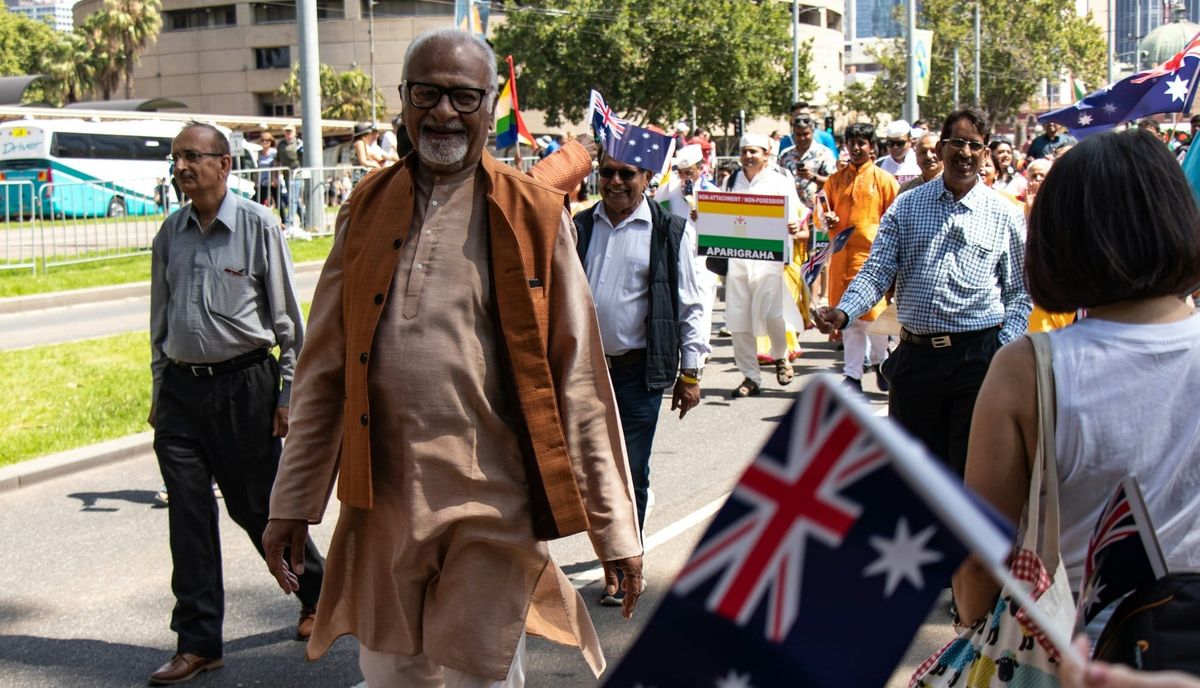
According to new data released by the Australian Bureau of Statistics, 971,020 Indian-born residents now live in Australia — narrowly edging out the 970,950 Australians born in England. Each group makes up roughly 5.2 per cent of the country's population.
It is the first time the English-born population has been displaced from the top spot since records began.
The shift is small in absolute numbers — barely 70 people separate the two — but the trajectory tells the real story.
In June 2024, just 12 months earlier, England-born residents were comfortably ahead at 963,560, compared with 916,330 Indian-born residents.
In the space of a single year, more than 50,000 Indian migrants have either arrived or been added to the resident count, while the English-born population grew by less than 8,000. The crossover was effectively inevitable.
England's peak was reached more than a decade ago, in 2013, when over one million England-born residents called Australia home.
That figure has steadily declined since. India, meanwhile, has been climbing relentlessly through every census and annual estimate since the late 1990s.
A puzzle: how is this happening when policy still favours the English?
Australia's modern migration system has, on paper, never been particularly biased in favour of one nationality over another.
But its underlying structures — English-language testing, skills assessments aligned with British-style qualifications, points awarded for Western-style work experience and partner skills — have historically been seen as advantageous to migrants from English-speaking, Commonwealth backgrounds.
So how are Indians overtaking the English at all?
The answer lies in the fundamentally different ways the two nationalities now arrive in Australia.
The English pathway: family, history and lifestyle
For decades, English migration to Australia was dominated by the assisted passage schemes that brought hundreds of thousands of "Ten Pound Poms" to the country in the post-war era.
Those waves shaped suburbs, accents and football clubs across Australia for generations.
The modern English migrant, however, looks very different.
Most arrive through partner visas, employer-sponsored skilled streams, working holiday extensions or as professionals already established in international careers — engineers, healthcare workers, teachers, finance professionals — moving largely on lifestyle grounds rather than economic necessity.
England-born numbers are no longer being driven by mass migration; they are being slowly replenished by a steady but modest flow of established mid-career professionals and family-stream arrivals.
The English-born population is also ageing.
The median age of Australia's England-born cohort is now over 60. Many migrated decades ago and are gradually moving into retirement — with deaths within that cohort increasingly outpacing fresh arrivals.
The Indian pathway: study, skill, settle
The Indian story could not be more different — and it is the engine behind the milestone.
The vast majority of Indian migrants now arriving in Australia are following what has become known as the "study-to-PR" pathway: enter on a student visa, complete an Australian qualification, transition to a Temporary Graduate (485) visa, gain Australian work experience in a high-demand occupation, and then move to a Permanent Skilled visa.
ABS analysis confirms this is the single most common visa pathway to permanent residency in Australia today, accounting for 36 per cent of all permanent migrants who first arrived on a temporary visa. India and China dominate this pipeline.
The Indian cohort is also dramatically younger than the English one — with most Indian arrivals in their twenties and thirties, settling in capital cities, raising families, and contributing to the workforce in IT, healthcare, engineering, accounting and education.
The introduction of the four-year Skills in Demand (SID) visa in late 2024, designed to plug critical workforce shortages, has further accelerated the trend.
Australia's 2025–26 Migration Program has allocated 185,000 places, with skilled migration the dominant share — and Indian applicants consistently rank among the most successful, particularly in healthcare, IT and engineering.
The Australia–India Economic Cooperation and Trade Agreement, signed under the previous government and continued by the current one, has further locked in protected post-study work rights for Indian graduates, ensuring stay periods are not impacted by recent broader visa tightening.
A milestone with political consequences
The crossover comes at a politically charged moment for Australia.
Immigration has become a national flashpoint amid the country's worst housing shortage in a generation.
The populist One Nation party has surged in the polls campaigning on lower migration intakes, and major parties have responded by tightening student visa rules, raising English-language thresholds and limiting "visa hopping."
But the structural realities of Australia's labour market — and the demographic ageing of its long-term English-born cohort — mean the Indian-born population will almost certainly continue growing in the years ahead, with the gap widening rather than narrowing.
For a country built on successive waves of migration, the symbolism of India overtaking England is hard to overstate.
It is a quiet but unmistakable signal that modern Australia is no longer just a former British colony absorbing arrivals from the mother country