'We are the only country in the world stupid enough to allow 'Birthright' Citizenship!': Trump's outburst revives a debate Australia had 40 years ago
United States President Donald Trump has sparked an international firestorm after sharing a social media post that branded China and India among "hellhole" countries, as he intensifies his fight to end birthright citizenship.


The controversy erupted on Wednesday when Trump reposted a lengthy four-page transcript from conservative commentator Michael Savage on his Truth Social account.
The excerpt, from Savage's Newsmax appearance following a US Supreme Court hearing on Trump's executive order to abolish birthright citizenship, contained explosive anti-immigration rhetoric.
"A baby here becomes an instant citizen, and then they bring the entire family in from China or India or some other hellhole on the planet."
"You don't have to go too far to see that," the transcript read.
"English is not spoken here anymore."
"There's almost no loyalty to this country amongst the immigrant class coming in today, which was not always the case."
The comments went on to allege that white men "need not apply" for tech industry jobs in California, claiming Indians and Chinese dominated hiring in Silicon Valley.
The piece also attacked the American Civil Liberties Union — which is litigating against Trump's executive order — calling it a "gangster criminal organisation" and accusing its attorney Cecillia Wang of "pushing to destroy our national identity."
Trump shared the content without adding any of his own commentary — but his decision to amplify the remarks to his vast follower base was enough to trigger diplomatic fallout.
India's Ministry of External Affairs fired back in a rare public rebuke on X, with spokesperson Randhir Jaiswal branding the comments "obviously uninformed, inappropriate and in poor taste" — stopping short of naming Trump directly, but leaving little doubt who the message was intended for.
Indian-American advocacy groups went further.
The Hindu American Foundation said it was "deeply disturbed" that the President would endorse what it described as "racist screeds," warning the rhetoric could stoke xenophobia and endanger communities.
The White House defended Trump's decision to repost the remarks, with spokesman Desai pointing to the President's "strong friendship with Prime Minister Narendra Modi" and his affection for "patriotic Indian Americans who were an important bloc in the historic election victory."
The constitutional fight in America
The backdrop to Trump's repost is a Supreme Court case expected to deliver judgment by the end of June on the legality of his executive order seeking to end birthright citizenship.
Birthright citizenship in the United States is enshrined in the 14th Amendment, ratified in 1868, which states:
"All persons born or naturalised in the United States, and subject to the jurisdiction thereof, are citizens of the United States."
Since the landmark 1898 decision in United States v. Wong Kim Ark, this has been interpreted to grant citizenship to nearly all children born on US soil, regardless of the immigration status of their parents.
Trump's executive order, signed within hours of taking office in January 2025, seeks to deny automatic citizenship to children born in the US to parents who are undocumented or in the country temporarily.
The Migration Policy Institute estimates more than 250,000 babies born annually could be affected.
"We are the only country in the world stupid enough to allow 'Birthright' Citizenship!" Trump posted earlier this month after the Supreme Court hearing.
That claim, however, is incorrect.
Roughly three dozen countries still offer some form of unrestricted or conditional birthright citizenship — including Canada, Mexico and most of Latin America.
Australia had this fight — and won it — four decades ago
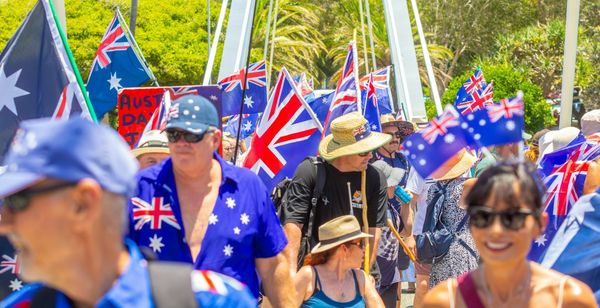
For Australians, the American debate feels strangely familiar.
That's because Australia had the very same argument back in the 1980s — and quietly settled it.
Until August 20, 1986, Australia operated under the British common law principle of jus soli — "law of the soil" — granting automatic citizenship to anyone born on Australian soil, regardless of their parents' status.
But a 1985 High Court case changed everything.
In Kioa v West, a Tongan couple who had overstayed their student visas argued that the Australian-born citizenship of their infant daughter Elvira gave her — and by extension them — a legitimate expectation of being allowed to remain in Australia.
The family lost the case, but it exposed what the Minister for Immigration and Ethnic Affairs of the day described as "a generosity in our law [that] can be exploited by visitors and illegal immigrants who have children born here in order to seek to achieve residence in Australia."
The Australian Parliament moved quickly — and with bipartisan support — to pass the Australian Citizenship Amendment Act 1986, which abolished pure birthright citizenship and replaced it with a system based on jus sanguinis, or "law of blood."
Today, a child born in Australia is only automatically an Australian citizen if at least one parent is an Australian citizen or permanent resident at the time of the child's birth.
A secondary pathway allows children to claim citizenship if they live in Australia for their first ten years of life.
Critics have long argued the 1986 reform was driven in part by xenophobic fear-mongering, particularly around rising Asian immigration in the 1970s and 1980s.
Others argue it was a reasonable measure to prevent migration law from being circumvented.
A fundamental legal gap
What makes Trump's task so much harder than the one faced by the Hawke Government is the constitutional architecture.
Australian citizenship is governed by ordinary legislation, which Parliament can amend with a simple majority.
American birthright citizenship is constitutionally protected — and can only be meaningfully altered through a constitutional amendment, a process that requires two-thirds of both houses of Congress and ratification by three-quarters of the states.
It is why legal experts across both countries broadly expect the Supreme Court to strike down Trump's executive order.