Man's homemade EV charging 'hack' goes viral — and the internet is not impressed
A Facebook post claiming a DIY generator strapped to a Chevy Bolt's wheel could charge an electric vehicle's battery while driving has gone spectacularly viral — for all the wrong reasons.


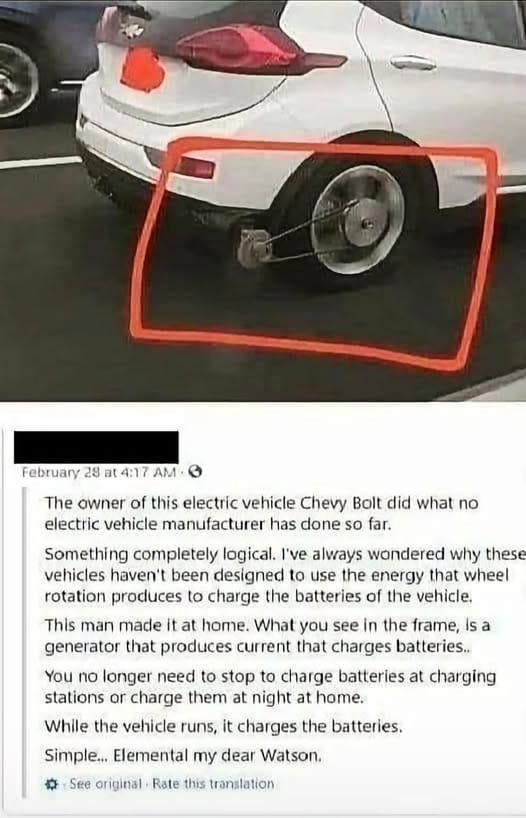
The Facebook post, which has racked up dozens of comments, features a photograph of a white Chevy Bolt in a car park with what appears to be a small generator attached via a chain to the rear wheel, enclosed in a makeshift frame.
The original poster was enthusiastic about their discovery.
"The owner of this electric vehicle Chevy Bolt did what no electric vehicle manufacturer has done so far," the post reads.
"Something completely logical."
"I've always wondered why these vehicles haven't been designed to use the energy that wheel rotation produces to charge the batteries of the vehicle."
"What you see in the frame is a generator that produces current that charges batteries," the poster wrote.
"You no longer need to stop to charge batteries at charging stations or charge them at night at home."
"While the vehicle runs, it charges the batteries. Simple… elemental my dear Watson."
The internet, however, was not impressed.
The comments section became an impromptu physics class, with users lining up to explain why the concept, essentially a perpetual motion machine, violates the fundamental laws of thermodynamics.
"Congratulations, you've just invented a perpetual motion machine!" wrote Jeremy Gray.
Kevin Thompson went further, crunching the numbers.
"An automotive alternator is at best about 50-60 per cent efficient, so to provide 100 watts of energy to charge the battery would require about 200 watts of energy — and where does that come from?", Thompson asked.
"The vehicle's propulsion battery. It's a good way to run it flat in a hurry."
Self-described electrical engineer Graham Smith was equally blunt.
"The extra load on the motor negates the generation because of inefficiencies and conversion losses. That's why we haven't done it."
Several commenters pointed out that the concept already exists in a far more sophisticated form.
"Every EV does this through using its motor as a generator every time you lift your foot off the accelerator," wrote Gordon Melvin.
He added that on his own EV, the brake pads only engage below 5km/h, with all other braking energy fed back into the battery.
"Regenerative braking is a thing. It's not that thing, but it is a thing," noted Kevin Moore.
Others were less charitable.
"This post would never have been birthed if the poster had made it into high school," wrote Vanessa Mercer.