Why EV cars don't have solar on roof | Could an axle-mounted generator actually work?
Could a $2 idea hidden inside your car's axle finally crack the EV range problem?

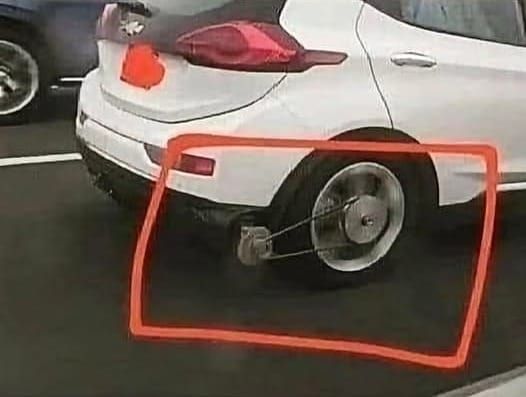
When a reader responded to our story about a viral Facebook post featuring a chain-driven generator bolted to a Chevy Bolt's wheel, most commenters were united in their ridicule of the perpetual motion fantasy.
But one response stood out from the crowd.
"This is a great concept but it can be done — not in this way, but within the axles, similar to how a magneto works," wrote Terry Curran.
"Magnetos produce their own current without any external power source."
It was a comment that deserved a closer look. So, is Terry onto something?
The short answer is: partly yes, and the automotive industry has been quietly working on exactly this principle for years.
A magneto generates electrical current through rotating magnets passing a conductor — no external power required to sustain the magnetic field.
Terry's instinct that this principle could be applied within a wheel hub, rather than bolted clumsily to the outside of a tyre, is one that has already attracted serious engineering attention globally.
British company YASA, now owned by Mercedes-Benz has developed an axial flux in-wheel motor that integrates directly into the wheel hub.
The company says the technology's "incredible regenerative performance" could "dramatically downsize, or even potentially negate" the need for conventional braking systems on the rear axle.
It could also potentially save up to 500 kilograms of vehicle weight if the broader architecture is optimised around the system.
Munich startup DeepDrive has gone even further, integrating its dual-rotor in-wheel technology into test vehicles, with early drives suggesting preconceptions about in-wheel motors, such as increased noise or handling problems, "no longer necessarily apply to modern developments."
But here is where Terry's magneto analogy runs into the same wall that tripped up the original Facebook post, just at a more sophisticated level.

A magneto doesn't violate physics. It converts mechanical energy into electrical energy. The mechanical energy still has to come from somewhere.
In a wheel hub generator, that somewhere is the car's own momentum.
During acceleration, adding a generator load means the drive motor must work harder, consuming more battery power than the generator produces.
You cannot come out ahead.
Where the technology genuinely shines and where EVs already exploit it is in recovering energy that would otherwise be wasted.
Research shows that all-wheel-drive EVs fitted with in-wheel motors can recover up to 31 per cent more energy during braking than conventional single-axle drive vehicles.
This is achieved by simply turning each wheel hub into a generator the moment the driver lifts off the accelerator.
Terry's magneto instinct, in other words, is the engineering principle behind regenerative braking — one of the most important technologies in modern EVs.
The distinction that matters is this: you can harvest energy you were going to throw away as heat through braking. You cannot manufacture free energy while driving at speed.
The viral Chevy Bolt contraption failed because its creator tried to do the latter.
The former is already in your EV — and engineers are working hard to make it even better.