'WE DIDN'T LOSE OUR GUNS': 4WD TV's Simon Christie says
4WD TV owner and presenter Simon Christie has made waves on social media this week with a candid post showing off his Australian-made rifle from his 4x4 travels — and challenging what he says are misconceptions about Australian gun ownership.

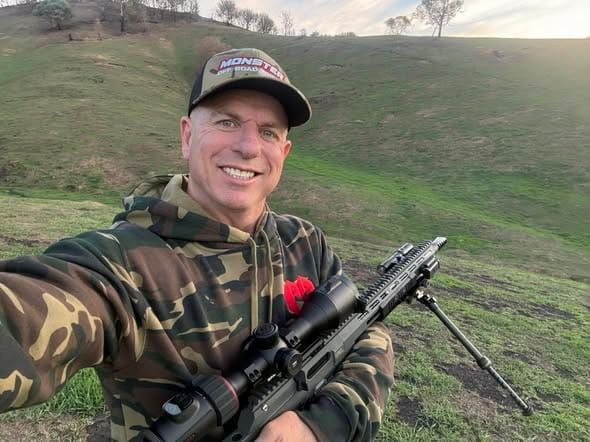
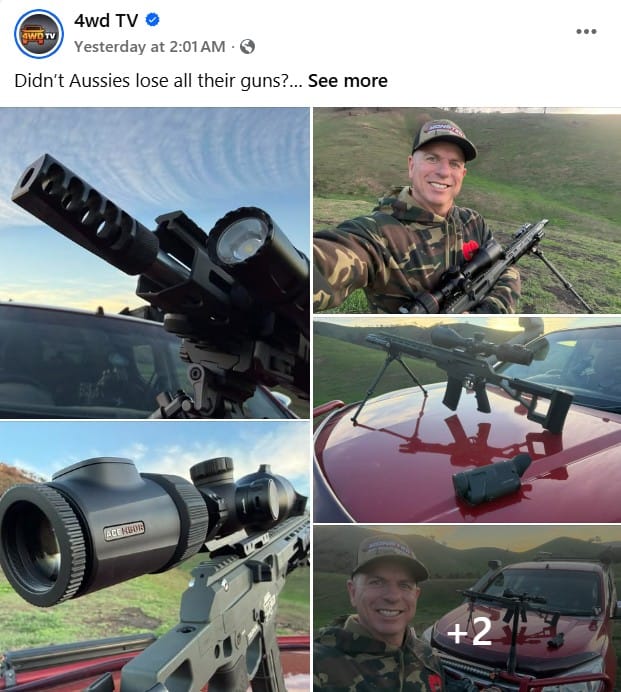
In the now viral social media post, Christie posed three questions and answered them himself.
"Didn't Aussies lose all their guns? No we didn't!"
"Are semi autos banned? No they were just reclassified!"
"Do guns and 4x4s go together? How else would we get out there?"
The 4WD TV boss showed off his SCSA Taipan X — an Australian-made rifle chambered in .223 — kitted out with a Vipertek bipod, a Nocpix thermal scope, ADI ammunition supplied through OSA Australia, and a MANAEL muzzle brake and foregrip.
"Please don't comment with stupid assumptions if you don't know much about firearms or what they're legally used for," Christie wrote.
So how do his three claims hold up under fact-checking? The answers are nuanced — and Christie is mostly correct, but with important context.
Did Aussies lose all their guns? — Mostly TRUE in spirit
Christie's first claim — that Australians did not lose all their guns — is technically accurate. The 1996 National Firearms Agreement (NFA), which followed the Port Arthur massacre, did not represent a blanket gun ban.
Australians retained the right to own most rifles, shotguns and certain handguns, subject to strict licensing.
What the NFA did was prohibit a specific category of firearms — most semi-automatic and pump-action long guns.
The 1996–97 National Firearms Buyback purchased approximately 643,000 to 660,000 newly prohibited firearms from civilian owners at market value, with all confiscated weapons destroyed.
A further 60,000 non-prohibited firearms were voluntarily surrendered.
Australia today has more than 3.5 million registered firearms in civilian hands — significantly more than before the 1996 reforms in raw numbers, though spread across far more individual licence holders.
Are semi autos banned? — PARTIALLY TRUE but more complicated
Christie's second claim — that semi-autos were "just reclassified" — is the trickiest of the three.
The strict reality: most semi-automatic rifles and self-loading shotguns ARE banned for general civilian ownership in Australia.
They have not simply been "reclassified" into accessible categories.
What Christie is more likely referring to is the legitimate workaround that has emerged in the Australian firearms market — manufacturers like Southern Cross Small Arms have designed rifles that retain the ergonomics, look and feel of modern sporting rifles (MSRs) while complying with Australian law by using manually-cycled actions instead of semi-automatic mechanisms.
The Taipan X is the perfect example.
While Christie referred to it as "technically a bolt action rifle," it is more accurately classified as a spring-assisted pump-action rifle with a removable straight-pull bolt option — a Category B firearm under Australian law.
That makes it accessible to recreational hunters and primary producers with the appropriate licence, in most states.
The Taipan X uses an AR-15-compatible magazine well, AR-15-style magazine release, and accepts standard 10-round Magpul magazines.
To the eye, it looks remarkably similar to an AR-15. But because it is manually cycled — every round requires the shooter to physically operate the pump or straight-pull bolt — it is not a semi-automatic firearm.
The rifle has been approved as Category B in every Australian state and territory except Tasmania.
Western Australia initially refused the Taipan classification but, after an appeal by SCSA, it was eventually approved.
So strictly speaking, semi-autos remain banned for most civilians in Australia — but innovative Australian manufacturers like SCSA have produced legal alternatives that retain the look, magazine compatibility and follow-up shot capability of MSRs without breaching the NFA.
Do guns and 4x4s go together? — TRUE in regional and remote Australia
Christie's third question is rhetorical, and most regional Australians would agree with him. For licensed hunters, primary producers and recreational shooters, the 4x4 vehicle and the rifle have always been deeply intertwined.
Pest control on stations across the WA outback, deer culling in the Pilbara, fox baiting in agricultural regions, and feral pig management in northern Australia all rely on the ability to access remote terrain — which usually means a 4WD.
Australia has approximately 800,000 to 1 million licensed firearms holders, with significant concentrations in regional and rural areas where firearms are often considered essential workplace tools rather than recreational items.
The current landscape
It's worth noting Christie's post comes at a politically charged moment. In December 2025, Prime Minister Anthony Albanese announced a new national gun buyback program in the wake of a deadly mass shooting in Sydney.
Several states have also introduced firearm caps in recent years — Western Australia in 2024 limited recreational hunters to five firearms and farmers to ten, while New South Wales passed similar legislation in late 2025.
For Christie, his Taipan X represents what he sees as the best of what's still legally available in Australia — a homegrown, well-engineered rifle that proves Aussie shooters and adventurers haven't been left out in the cold.