'WE KNOW HOUSEHOLDS ARE STRUGGLING' | $100 fuel handout the surprise winner of WA Budget
Western Australian drivers will pocket a surprise $100 fuel voucher under a sweeping cost-of-living relief package unveiled by Treasurer Rita Saffioti — even as she handed down a whopping $3.5 billion State Budget surplus.


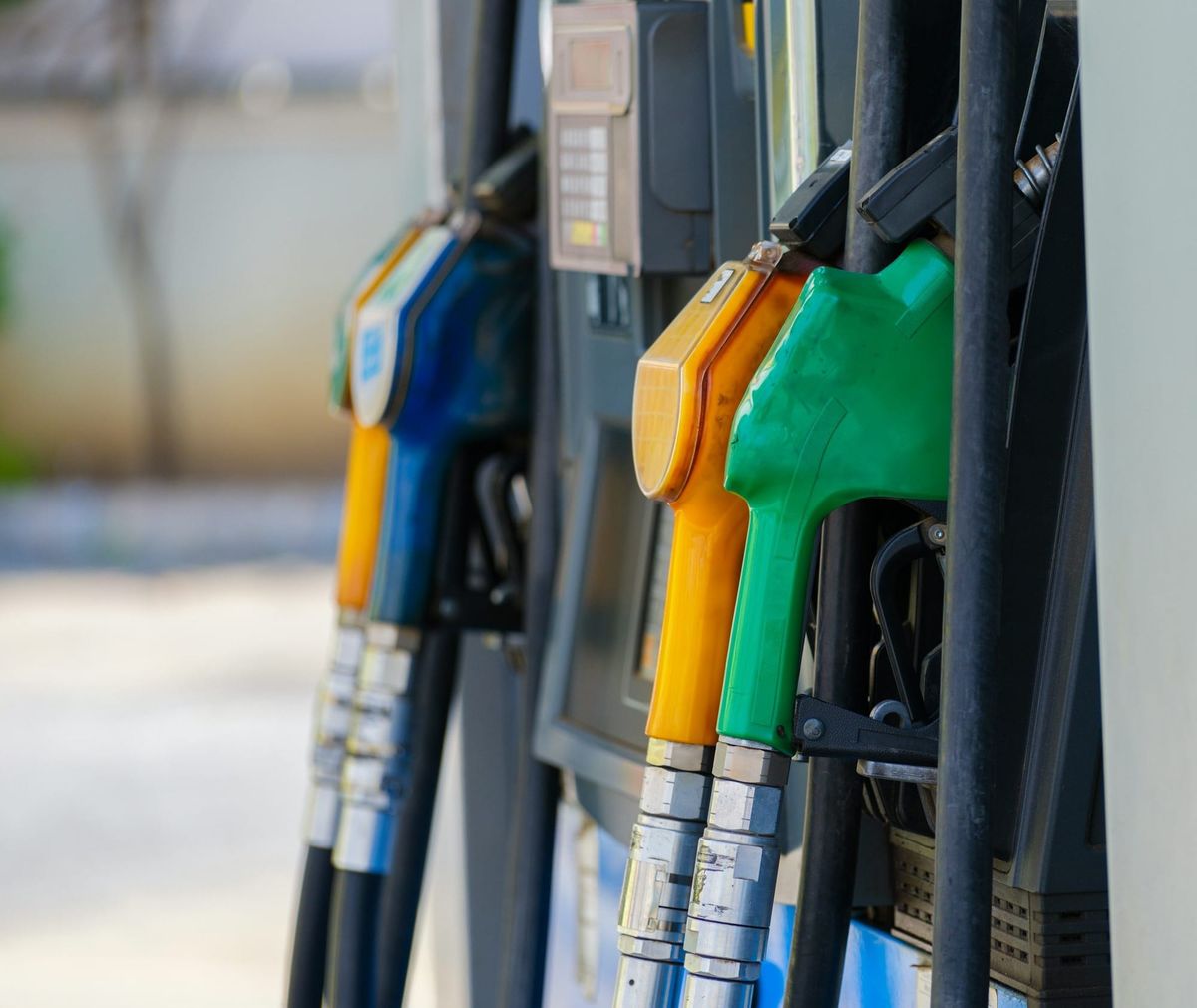
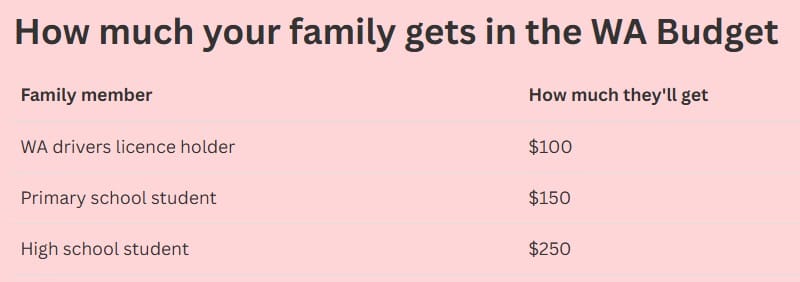
The fuel voucher, which Ms Saffioti described as "extraordinary," will be issued to every holder of a WA driver's licence regardless of how it is ultimately spent.
While not technically restricted to fuel purchases, it has been pitched as a direct response to soaring petrol and diesel prices that have strained household budgets across the State.
The Treasurer brushed off suggestions that the Reserve Bank of Australia, currently grappling with rising inflation, may take a dim view of the move.
"Well, I didn't like their interest rate increase," she said.
The handout falls short of filling the average diesel tank — but Ms Saffioti insisted it would help keep families and workers on the road during a difficult economic period.
"We know that households face challenges in balancing their budgets," the Treasurer said.
"In particular, since the recent global economic upheaval."
Student assistance payments boosted
Alongside the fuel rebate, the Budget delivers a third round of student assistance payments — $150 for primary school students and $250 for high school students.
The Treasurer was quick to point out that the cumulative impact of the various measures could add up significantly for families.
"It's a significant amount when you add all of those things together," Ms Saffioti said.
"This means a family of four with two kids in high school would be eligible to receive $700."
The student payments have been broadly welcomed by parents groups across Perth, who have flagged the rising cost of school supplies, uniforms, devices and excursions as one of the steepest household pressures families are currently facing.
 WTV
WTV
Concession card holders also receive a boost
In a notable lift, assistance to concession card holders for electricity and water charges will increase by 10 per cent — outpacing the 2.5 per cent rise in those utility charges, which itself sits below the inflation rate.
For pensioners, low-income earners and other concession-eligible West Australians, the additional support will provide some buffer against rising essential service costs.
But the small print bites
For all the cost-of-living relief on offer, the Budget also slips in a series of upward adjustments that will eat into household budgets in other ways.
Motor vehicle charges will rise by 3.4 per cent, hitting every WA driver in the form of registration and licensing increases.
The emergency services levy — which is added to council rates and helps fund the Department of Fire and Emergency Services — will rise by 5 per cent, a notable jolt for ratepayers already preparing for council rate notices and concerned about the broader cost of homeownership in the State.
These adjustments mean that, depending on individual circumstances, the headline relief measures may not fully offset the increases buried elsewhere in the Budget papers.
The 'representative household' modelling
The State Government's own modelling claims a "representative" WA household will be $221.89 better off in 2026 as a result of the Budget package — but the assumption built into that figure has raised eyebrows.
To achieve the $221.89 saving, the modelling assumes that students catch public transport every day, and that parents leave the car at home three days per week.
For many WA families — particularly those in outer suburbs and regional areas where public transport options are limited — both assumptions are unrealistic.
For those families who continue to rely heavily on private vehicles for work, school drop-offs and childcare runs, the savings claimed in the Budget papers will be considerably harder to achieve in practice.
A surplus Budget with one eye on inflation
The $3.5 billion surplus continues WA's run as the strongest performing State economy in the country, underpinned by sustained royalty income from the iron ore and resources sector.
But economists have already begun questioning whether handing direct cash payments to every licence holder — at a time when the RBA is actively trying to cool inflation — represents prudent fiscal policy or political opportunism.
The Treasurer, for her part, has been clear about her priorities. Households first.
"We know households are struggling," Ms Saffioti said.
For now, WA drivers will simply be checking their letterboxes — and waiting for the $100 to land.
 WTV
WTV